
Cajal’s Networks
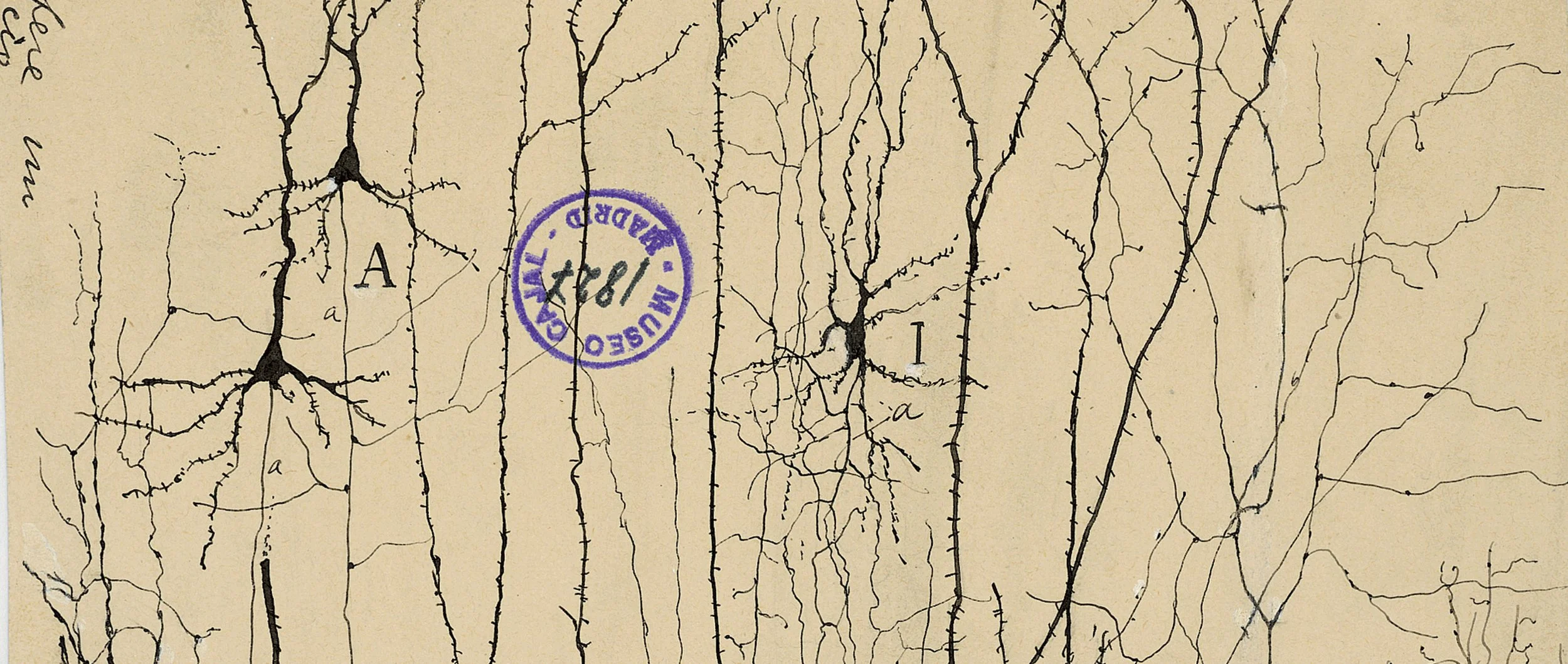
Cajal’s drawings of neurons helped reveal that the nervous system is not a single continuous web (as many believed) but a constellation of separate individual cells held together by relation.
Courtesy of the Cajal Institute and the Spanish National Research Council
Long before artificial neural networks became the preferred metaphor for machine intelligence, Santiago Ramón y Cajal (my favorite Spanish artist and neuroscientist) was drawing the actual tissue that makes thought possible. Working in the late nineteenth and early twentieth centuries, he mapped the nervous system with a level of precision that was not only scientific but also creative, with a heavy dose of primal knowledge. His drawings of neurons, dendrites, and branching pathways still feel so alive because they document anatomy and reveal the principle that intelligence is not housed in one sovereign location. Instead, it emerges through contact, pathways, interruptions, densities, and exchanges that only make sense as part of a larger whole.
That is why his work still matters outside neuroscience. It offers a visual language for understanding how complex systems work at every scale. As I often love to point out, the same rules appear in mycelial networks beneath the forest floor, in telecommunications, transit maps, electrical grids, and in the invisible designs that organize digital life. Different materials and consequences, but the same structural logic of connection.
What I really appreciate about this metaphor is that it moves us away from isolated objects and closer towards patterns, which informs my personal understanding of systems design. A network, rather than being a dense pile of nodes, is a specific setup that determines what circulates and what gets filtered out, a process that can involve memory, action, adaptation, exchange, attention, and behavior.
This is also where the political and ethical dimension enters. As discussed in Zuck Found Guilty, modern discourse still tends to fixate on content, suggesting that output is the main event. Cajal’s drawings suggest something more sensible, which is that the pattern is the event. Plus, the architecture of connection determines the terms under which anything matters in the first place, and once that creeps into the foreground, design becomes environmental, not as a vortex for human activity, but as a software that makes our random thought trains easier to sustain.
What Cajal shares with us is not exactly an artistic record of the nervous system so much as a way of thinking across disciplines without collapsing them into each other. Biology is not the internet, and mycelium is certainly not social media. A neuron will never be a fiber-optic cable, but the analogy remains incredibly useful because it brings a shared truth to light, which is that systems are defined less by their parts and more by the patterns that link them. Once you see the world through this lens, connection becomes less vague (or spiritual) and more like an ever-evolving AutoCAD design of the natural world. That said, our open-ended question as a species is not about whether everything is connected like an algorithm, but rather what forms of life these patterns permit.
More Information
Cajal was a Spanish neuroscientist, pathologist, and histologist whose research helped lay the foundations of modern neuroscience. Born in 1852 in Petilla de Aragón, Spain, he trained in medicine at the University of Zaragoza and later served as a military doctor, going on to become one of the most influential investigators of the brain’s microscopic structure. Using and refining Golgi’s method, he produced extraordinarily detailed drawings of neurons and neural tissue that transformed how scientists understood the nervous system. His work supported the neuron doctrine, the idea that the brain is made up of individual nerve cells communicating across connections rather than one continuous mesh. In 1906, he shared the Nobel Prize in Physiology or Medicine with Camillo Golgi, and he is still widely regarded as a founding figure in modern neuroscience.
